Showing posts with label Saints. Show all posts

Thursday, August 28, 2014

Honoring St. Augustine, the "Great Sinner"

Today in the Church we memorialize one of the most influential thinkers in the history of the world and a Saint whose battles with sin ought to be especially present to childlovers who also battle. His life gives us an example of overcoming the odds within ourselves by the grace of God.

St. Augustine is known as the "Great Sinner," for he lead half his life in 4th century Algeria in the shadow of his own vanities and despair, lusts, drunkenness and excess, self-centeredness, thirst for power and the unresolved issues against his parents (mostly his father, whom he ended up following into a life of similar dissipation anyways). He was "restless," according to his own later description, always looking for happiness in all the wrong places, seeking and never finding. This "great sinner," not unlike each of us, was a creature of pleasure-seeking and habit who sought a rhetorical kind of self-advancement over truth and often faced the consequences of such. He was even a part of the Manichean religion at one point, a very dualistic path that emphasizes the "evil" of the created world and the passions. He was indeed a very divided, despairing, and ultimately fruitless man in his youth. He even famously wrote on how his prayer life was something along the lines of: "God, grant me chastity and continence, but not yet." (Confessions)

So why is he now among the greatest minds who ever lived? Why do we reverence such a man? How much different was he than any of us? The point is he wasn't. In short, he came to know God, came to confess Christ as savior, became a priest, founded an order of monks, became the bishop of Hippo, wrote a lot of influential books and died defending his order and fellow believers from vandals. He has since been canonized and declared a Doctor of the Church for his life and writings. These are all very impressive things, but the greatest gift this man gave out of his own life was completely God-given. It was the eternal wisdom of God. 

Very much like ourselves as childlovers, St. Augustine struggled with bad habits, but came to understand by the grace of God in his life that simply struggling with sin is not what makes us, for all struggle under various sins. The difference between a mere sinner, or even a "great one," and a saint is that a mere sinner is ultimately hurt by his sin while a saint overcomes his sin by the grace of God. But how does this happen? How do we overcome our bad habits? St. Augustine wrote much of his own life in the long prayer to God that is his book Confessions, saying that: "Because my will was perverse, it changed to lust, and lust yielded to become habit, and habit unrestricted became necessity. Thus I came to understand how the flesh lusts against the spirit, and the spirit against the flesh." (Confessions)

Your choice defines you.
Taking the cue from the writings of St. Paul (Galatians 5:17), automatically is set up here for us two different "wills," the perverse and the holy. The perverse will encounters lust, for example, feels its feelings, consents to them, acts on them, and feels the consequences in some way (and death results, ultimately). A holy will encounters the same lust, feels the same feelings, doesn't consent to them, doesn't fear them, but uses them for the glory of God instead, and then feels the blessings that result after time and perseverance, as St. Paul writes: "Not only so, but we also glory in our sufferings, because we know that suffering produces perseverance; perseverance, character; and character, hope" (Romans 5:4). The perverse will can not become holy on its own (how can it?) and the holy will likewise can not become perverse, for the perverse will pursues lust exclusively for its own sake, which produces sin (and death, a "wage of sin"), and the holy will makes use of lust for the glory of God, which produces righteousness (a gift of God... Romans 6:23). 

But there is no battle between these two wills over the destiny of our souls that we are merely caught up in and can't do anything about, only choices and how we respond to the things we feel and see. We need not fear lust, nor pursue any gift or blessing, but always seek the will of God in all things. Just like the "desire" and "intention" to pray does not equate with prayer, but only the consent and action of prayer does, the mere "desire" and "intention" toward lust does NOT equate with "sin," but only the consent and action of lust, which is born in the "heart" (as Christ spoke in Matthew 5:27-28). Therefore, the mere feeling of "lust" is like all things a neutral feeling and NOT inherently "evil" (as the Manicheans believed), because a perverse will will use it as an opportunity to sin (as we all do at times), but a holy will will use it as an opportunity to pray and practice charity, which is righteousness. How can that which can be used to provoke righteousness be inherently evil? With a holy will, it can't. This St. Augustine came to understand. 

But how do we make the leap between the "downward" spiral (or bad habit) of a perverse will occasioning sin encouraging a perverse will...etc, to the "upward" spiral (or good habit) of a holy will occasioning prayer and charity encouraging a holy will...etc.? And especially, how can it be done if the one can never lead to the other by natural, logical, or human means? For that we need super-natural means. For that we need Jesus Christ. Not just His Teaching, but Jesus Christ Himself. But how is this leap accomplished? Paradoxically, it is occasioned in the very experience of imperfection itself, the one thing common to the experience of every will whether "perverse" or "holy." The "lust desire" on its own, like the inclination to sin itself, is the ONLY common variable, the only common experience between the upward (holy) cycle and the downward (perverse or "vicious") cycle. So just as this point is where a holy will can become perverse by inclination (temptation) and lead to sin and the downward cycle, it is also the point at which a perverse will can become holy by inclination (God Himself) and lead to righteousness and the upward cycle. 

Basically, when one encounters a lust desire, or any sin, one can make the choice to use the occasion as a call to sin and declare "party time!" or, one can make the choice to use the occasion as a call to righteousness and declare "prayer time!"

"Party time" pleasures the body immediately but is ultimately full of consequences that end up ensnaring and enslaving us or at least making us unfruitful both immediately and in the long run (by the creation of bad habits). "Prayer time" often deprives the body but causes fruitfulness and avoids the consequences by establishing good habits wrought in labor and devotion and the love of God and neighbor. 

The good news St. Augustine teaches in his writings is that of Christ, namely that: "In this world you will have trouble. But take heart! I have overcome the world" (John 16:33). This is especially emphasized in Augustine's book City of God. His great contribution to the history of human thought is that ultimately the choices before us are a gift from God and that they influence our will, which in turn influences our choices. In the moment we feel lust or any fleshly desire, no matter how intense (and often because of its intensity!), both wills become available to us and the action is what is chosen and the result is what is in the judgement of God. Our experience of any inclination to sin and how our choices affect us are unchosen and unchangeable, but our will and our action is always chosen and changeable.

Let us echo the words of Augustine in our prayers: "[Lord] You have made us for Yourself, and our hearts are restless until they can find rest in You" (Confessions). Remember, lust and desire for sin is an opportunity permitted by God for you to choose righteousness (like He permitted the "fruit of knowledge" to be in the garden so man could have a choice), not a thing to be feared or to run away from. So use it for good! Desire it! And thus, the life of St. Augustine, and our own lives, bring to mind the words of the teacher in Ecclesiastes, the eternal wisdom of God: 
"However many years anyone may live, let them enjoy them all. But let them remember the days of darkness, for there will be many. Everything to come is meaningless. You who are young, be happy while you are young, and let your heart give you joy in the days of your youth. Follow the ways of your heart and whatever your eyes see, but know that for all these things God will bring you into judgment. So then, banish anxiety from your heart and cast off the troubles of your body, for youth and vigor are meaningless. Remember your Creator in the days of your youth before the days of trouble come and the years approach when you will say, "I find no pleasure in them" (Ecclesiastes 11:8-10, 12:1). 
St. Augustine, pray for us.  

Sunday, June 29, 2014

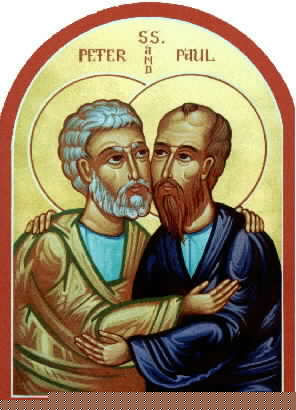
Made Perfect in Weakness: Sts. Peter and Paul

Today we're honoring two great Saints, Peter and Paul, and what their lives can teach us about what it means to be made complete or "perfect" despite our various inclinations and weaknesses and feelings of being "incomplete" as Childlovers. St. Paul once wrote on how the Lord had told him that "My grace is sufficient for you, for My power is made perfect in weakness" (2nd Corinthians 12:9). Both Peter and Paul were made to understand their weaknesses, and yet both were then exalted in the Lord because of them in ways they couldn't have foreseen. What can their lives teach us as Childlovers about relying on God to "fill our gaps" and make us more "complete?"

Like Childlove, Christianity is often misunderstood, whether due of ignorance or malice. Christianity often gets a negative reputation among those who misunderstand it for focusing so much on weakness and "guilt" about shortcomings. Ironically, it also gets a negative reputation from the degree of "self assurance" it provides people who are notoriously faulty. Simply put, it is all too easy to condemn it outright for being one or the other of these opposite things without understanding that what it actually teaches us is somewhere down the middle. And just as we all find ourselves at the "cross" between these opposing forces, we also find Sts. Peter and Paul. It is in the union of this opposition that we all find completeness, and nothing says "Godliness" like completeness, for God is Completeness itself. 

We can not be complete without both our strengths and our weaknesses, which often run opposed to one another and keep us from being complete as God is complete. But God has a way of turning our weaknesses into strengths in ways no human being could fathom beforehand (neither Simon Bar Jonah or Saul of Tarsus would've believed you if you told them what they would go on to do as "Peter" and "Paul" respectively). God can do this with whatever tempts and weakens us, be it LUST, ANXIETY, DEPRESSION, over-zealousness, or anything that Childlovers often struggle with. Often Christianity gets a negative reputation for focusing so much on one's weaknesses, but as the lives of the Saints teach us, there is no greater strength than one that is humbled by God, and no greater weakness than one that is self-exalted, and we see that weakness breeding a common "fruitful humility" in the lives of these rather opposite men. 

St. Paul, as we all ought to know, could be said to represent in his life and mission the "dynamism" of the Church and Christian faith in general, while St. Peter represents for us the "structure." To St. Peter was given the "keys of the Kingdom" by Christ (Matthew 16:19) and to St. Paul was given the mission to the Gentiles (the non-Jews) as its most energetic spokesman. In one amazing sense though, neither of these twin peaks of Christianity, gifted in many ways, were innately qualified to become what they eventually became, and neither would've done what they did of their own ability, as we'll see, but through them God shows us how much greater He is than we are by ourselves and therefore how much more complete we can be with Him than without Him. God doesn't merely want to play to our strengths but to fill our gaps, so that we have reason to praise and be thankful and not count upon our own abilities but only count upon that which He grants. 

Saul humbled.
Becoming complete is a hard lesson to learn though because it goes against everything we're accustomed to, everything our hearts are telling us, but consider where both Peter and Paul started and where they ended up by the grace of God. Paul became the dynamic force of the early Church, bringing in the gentiles, debating doctrine, ruminating and constantly seeking new frontiers. He was a creative powerhouse, constantly adpating to new environments and conditions and making the best of what he had wherever he was (even if it was from a jail cell). This is the Pauline way. Peter became the "Rock" of the Church, one of the "pillars" (as Paul referred to him once), the source of structure, the guiding force, the shepherd of the flock, the great pastor dealing with the matters from within. This is the Petrine way.
 
Yet neither of these great men could attribute these feats to anything but God, just judging by how they started out. In fact, God couldn't have assembled two lesser qualified people for these roles than Simon Bar Jonah and Saul of Tarsus. Simon (Peter) was a simple fisherman, and not even a great one at that. He was a divided heart, "there with you" one minute and gone the next, wishy-washy, lukewarm, prone to "please men" at one minute and be over-zealous for God the next, but God saw the genuineness of his resolve wherever his heart might've taken him and said "I can work with that!" Saul (Paul) on the other hand, was completely the opposite. Raised at the feet of the great teachers of the Law, he was devoted to the Law, to discipline, to structure, even to the point that he had lost his "heart" for his fellow man and was persecuting the Church he saw as a threat to the established order. But God saw his love for the Law and the Word and said "I can work with that!" Both men allowed God to work with them in unexpected ways.

You'd think then that God would make the man of "heart" (Simon) the dynamic force and make the man of knowledge (Saul) the "pillar," but then either man could've claimed these offices were the result of their own abilities. Instead God, wanting to show His power made "great in weakness," turned each man's weakness into a strength greater than that of their own. Thus He made Peter the "Rock" of the Church and made Paul its greatest, most affecting and dynamic preacher. He sent the former fisherrman out to be the shepherd of the Jewish flock and sent the former Pharisee (a shepherd for the Jews in a way) out to be the "fisher of men" and bring the masses to the Mass. He who was strong in following his heart for the sake of men was made stronger for the structure of God, and he who was strong in structure for the sake of men was made stronger for the heart of God. Neither was this accomplished for their own sakes or by their own power "lest any man boast," but by the power and for the sake of God, so that their boast could only be in the Lord. Both were made complete by compliance, as God wills for every one of us.

At the same time, the Lord doesn't cause our natural strengths to go unused (why would He give us any strength or faculty that we couldn't use?), but rather completes them and allows them to thrive even more abundantly than they would have had we relied solely on them. You have to imagine that Paul's gift for knowledge of the Law and for discipline and structure obtained from his former life as Pharisee found its service for the Lord in greater abundance as he applied it towards the edification of the gentile churches. Likewise you have to imagine that Peter's gift of a genuine resolve and heart allowed him to better understand the heart of his fellow man when it came to his pastoral guidance within the Church, allowing him to better be the "pillar" upon which everyone turned for leadership. Thus each man also filled in each other's weaknesses with their own strenghts in a way that only God could "join together." No one could tear it asunder! 

Simon Peter humbled.
God completes us. God tells us Childlovers to go do and not do what we are most unwilling or unable to do or not do, and whatever our weaknesses tell us we can't do, and says "Just go do it. I know you don't think you're able or worthy, but guess what. It's not about what you feel or what you know. It's about what I command." Sometimes we can feel so unworthy of God that we fail to let him fill our weaknesses or humble our strengths, but this is no less prideful than if we presumed upon our worthiness. Both deny God the opportunity to "work with us." Both Peter and Paul were unworthy as men and deeply flawed, but both of them knew it, and both knew that God was ultimately greater than their weaknesses and so consented to be filled and to do what they were previously unable or unwilling to do. Because they gave that much, God was able to give them everything else. Because they gave God their weaknesses, God humbled their strengths and exalted their weaknesses beyond all reckoning. 

What are your strengths and weaknesses? Are you prone to lust? Anxiety? Depression? An over-emphasis on maintaining order or too divided in heart? Are you lead by your feelings and deny responsibilities, or are you lead by responsibility to the point of denying your feelings? Whatever it may be, God wants you to go beyond yourself, which is the essence of all true spirituality. Go beyond "you," even if it causes you anxiety, or despair, or even the pain of death or a life of self-mortification and solitude. Lose the "I" (that is ego), lose the "want" (that is desire), and what you are left with is exactly what the Lord is prepared to GIVE you: "peace," "rest," "truth," "friendship," "companionship," "completeness"...etc. All things that He alone IS. The fact is we all want to be God, but none of us are because none of us are complete like He is. The spirit He gives us is willing but our flesh is made weak. But God says to each and every one of us: "Admit the flesh is weak, and I can work on your willing spirit. Only then can I make that flesh like unto MINE." 

Sts. Peter and Paul, pray for us.

Wednesday, January 22, 2014

Honoring St. Agnes - Patron Saint of Girls

The reason we have a special fondness for children and why we don't want them to come to harm is because we see in them the value of a human life in all its true preciousness and meekness. We see how we would do well to extend this insight to others, because that is how God sees all of us. St. Agnes was only twelve (or thirteen) when she was martyred for her devotion to Christ. Her short and yet fruitful life was lived out during the persecution of Christians under the reign of the Roman emperor Diocletian in the early 4th century. She was said to be very beautiful, but she maintained her purity to the end, and so it is fitting that her name is Agnes (meaning "the pure one"). Along with being a martyr, she is also the patron saint of girls and rape victims. 

Legend has it that she was walking home from school when she was approached by a man named Symphronius, who happened to be the son of the city prefect. He was aroused by her beauty and tried to win her over with gifts to seduce her, but she rebuked him. She did not consent to his advances and strongly asserted that it was because she was already "betrothed to Christ." She reportedly told him something to the effect of: "With His ring my Lord Jesus Christ has betrothed me, and He has adorned me with the bridal crown" (3. Ant., Lauds).

The man didn't respect her request and became very indignant. He went home to his father and reported her for being a Christian (an offense punishable by death in those days). Seeing her youth and her beauty, they tried to sway her into incensing a pagan sacrifice and to renounce Christ and marry the man, and she adamantly refused, saying: "At my side I have a protector of my body, an angel of the Lord" (2. Ant., Lauds). It was said that upon entering the prefect's house, a light enveloped her such that nobody could look at her and the pagan priests noticed this and had her tried for sorcery. A judge sentenced her to death at the stake. They lit the fire around her to burn her, but it didn't kill her, and she reportedly gave thanks to God: "O You, the almighty One, who must be adored, worshipped, feared - I praise You because through Your only begotten Son I have escaped the threats of wicked men and have walked through the filth of sin with feet unsullied. I extol You with my lips, and I desire You with all my heart and strength." Afterward, the prefect ordered her beheaded (or stabbed to death).

St. Ambrose later wrote on St. Agnes's martyrdom in the 4th century very eloquently and fully grasping all her death has to teach us about the value of personal purity and the dignity of children:
"The cruelty that did not spare her youth shows all the more clearly the power of faith in finding one so young to bear it witness.
"There was little or no room in that small body for a wound. Though she could scarcely receive the blow, she could rise superior to it. Girls of her age cannot bear even their parents' frowns and, pricked by a needle, weep as for a serious wound. Yet she shows no fear of the blood-stained hands of her executioners. ... She is too young to know of death, yet is ready to face it. ... She puts her neck and hands in iron chains, but no chain can hold fast her tiny limbs. 
"A new kind of martyrdom! Too young to be punished, yet old enough for a martyr's crown... she shows herself a master despite the handicap of youth. ... What menaces there were from the executioner, to frighten her; what promises made, to win her over; what influential people desired her in marriage! She answered: "To hope that any other will please me does wrong to my Spouse I will be his who first chose me for himself. Executioner, why do you delay? If eyes that I do not want can desire this body, then let it perish." She stood still, she prayed, she offered her neck.
"You could see fear in the eyes of the executioner, as if he were the one condemned; his right hand trembled, his face grew pale as he saw the girl's perile, while she had no fear for herself. One victim, but a twin martyrdom... Agnes preserved her virginity, and gained a martyr's crown." *
It was said that her youth and her beauty in the midst of such torture caused all the onlookers terrible grief, and that even her persecutors trembled and broke down in tears over what they had done to her. Let us pray for children, keeping in mind that 1 in 4 girls and 1 in 6 boys are sexually abused before they turn 18*. As Childlovers, we do well to pray for children who are abused and remind ourselves never to become like the man in this story. 
St. Agnes, patron saint of children, watch over the children of the world; keep them safe from harm; be with them in their hour of need; and always pray for them.
As a childlover, say a prayer for girls (and all the children of God), reminding yourself of the words of our Lord: "If anyone causes one of these little ones--those who believe in me--to stumble, it would be better for them if a large millstone were hung around their neck and they were thrown into the sea" (Mark 9:42). May we truly grasp the meaning of these words. 

*Lib 1, cap. 2.5 7-9: PL 16 [edit. 1845], 189-19

Saturday, December 28, 2013

Honoring the Holy Innocents

Today we honor the small boys of Bethlehem slain by King Herod in his attempt to kill the infant Son of God and "newborn King." The Gospel tells the story simply: "Then Herod, when he saw that he was deceived by the wise men, was exceedingly angry; and he sent forth and put to death all the male children who were in Bethlehem and in all its districts, from two years old and under, according to the time which he had determined from the wise men" (Matthew 2:16). We honor these boys by having in mind all the children who are killed every day all around the world and praying both for the living, that they be kept from all abuse, neglect, murder, and abandonment, and for those already in the grip of death, that they may be welcomed into the Lord's face without hindrance, wearing robes of white.

The practice of praying for and asking God to bless children should also be very redemptive and edifying for the childlover and part of our daily devotions, but especially on this most sad occasion as we remember and honor all the children martyred in their innocence. If you see any child today (or any day), make it a practice to say at least "God, bless this child." You can also say this prayer below, or any heartfelt prayer of blessing for children: 
Let us pray. O Lord Jesus Christ, once You embraced and placed Your hands upon the little children who came to You and said: "Suffer not the little children to come unto Me, and forbid them not, for theirs is the kingdom of heaven, and their angels always see the face of my Father!" Look now with fatherly eyes on the innocence of your children, and bless them this day. In Your grace and goodness let them advance continually, longing for You, loving You, fearing You, keeping Your commandments. Then they will surely come to their destined home, through You, Savior of the world. Who lives and reigns forever and ever. Amen. 
We become better Christians, better childlovers, and better people when we pray for children. If you know any children (young friends perhaps), you can also say this prayer to ask God to bless them, or any heartfelt prayer of blessing:
O Lord Jesus Christ, Son of the Living God, Who begotten in eternity yet willed to he born in time as a child; Who loves the innocence of childhood and lovingly embraced and blessed the little children who were brought to You: anticipate the needs of [this child/these children] with Your tender blessings, and grant that no evil may corrupt [his/her/their] mind, but that advancing in age, in wisdom, and in grace, [he/she/they] may live so as to please You always. You Who live and reign with God the Father in the unity of the Holy Spirit, God, for ever and ever. Amen. 
A small treasury of prayers for children is being compiled here. Suggest one!

Grace and peace be to you, and to all the little children.

Friday, December 6, 2013

Honoring St. Nicholas, an Example for Childlovers

St. Nicholas is one of the most celebrated saints in the western world, and though he would've never desired such recognition to overwhelm the birth of Christ during the holiday season, the celebration of his legendary generosity and his love for children has become the symbol of Christmas in the modern world and is still beloved by children and adults alike. Sometimes childlovers can feel like Santa Claus, giving what we can for children without any expectation of reimbursement, and sometimes even to very demanding young friends(!), but charity is what we should model at all times, especially to children, as is St. Nicholas a good model for us. Today is his feast day. 

The real St. Nicholas, apart from his fame as "Santa Claus," was the bishop of Myra in the 4th century. He came from a wealthy family, the son of the archbishop of Myra, but he held the poor in his heart and was persecuted under the Roman emperor Diocletian. He was released by the mercies of God and the Christian emperor Constantine and became a bishop. He was always known for his generosity and his concern for the poor, and especially for upholding the dignity of children. 

It is said that once there was a father who had lost his fortune and became destitute, and realizing he could no longer support his three young daughters, contemplated selling them into prostitution in order to make some money. St. Nicholas heard this man's intentions and instead of merely condemning the man, decided to come by night and secretly throw three small bags of gold through the window anonymously, thus allowing the man to avoid committing that horrible sin of child prostitution and defiling his own daughters. He became known for his giving, especially to the poor and to children. Although many children flock to his image and make out their lists of wants and needs, St. Nicholas the man lives on teaching everyone, including children, the virtues of generosity, kindness, helping the poor, and perseverance in hardship (he was imprisoned after all!). 

For childlovers, the saint showed a compassion for children in jeopardy that is more than admirable and still more than needed in this world, and that is what Christian Childlove is all about. Often a childlover's good works for children go unnoticed and unappreciated, but St. Nicholas reminds us that charity is good work always and everywhere, and especially if we have it in our ability and power to go out and do something that will benefit our fellow younger friends. If you know any children, take time to consider whether you have ever been like the father in the story of St. Nicholas, and make the firm decision right now to be more like the man we celebrate today, who in giving what he could give to the poor and to the most vulnerable, was himself imitating our Blessed Lord, who gave us all the supreme gift of Himself, and who's birth and second advent we anticipate in this holy season of Advent.
St. Nicholas, glorious Confessor of Christ, assist us in thy loving kindness. Grant by your intercession that children who are suffering abuse, maltreatment, or neglect, may experience the hope of Christ in the charity of another, through Christ our Lord. Amen. 
Boy Bishops in honor of St. Nicholas - It has been a custom since the middle ages and especially in England to elect a "boy bishop" to parody the real bishop on  December 6th, in honor of St. Nicholas Day (the patron saint of children). 

On this day, a boy is elected from the parish to wear the bishop's vestments, wearing the mitre (the hat) and crozier (the shepherd staff) and then to "preside" at the mass (even getting to sit in the bishop's seat!) with the blessing of the bishop, along with his friends dressed as priests and praying for him. Traditionally this is done each day for him until the Feast of the Holy Innocents on December 28th. What a way to inspire the spark of a vocation in a youth!

Grace and peace be to you. 

Saturday, October 5, 2013

St. Placid (the Boy Monk) and His Rescuers

God repeatedly reminds us of the dignity of every child and how we are to respect and treat children by the examples of His saints, both young and old alike. The stories told about these people instruct childlovers about how they are to regard and act around children and youths. They show us how we are never to subject them to harm, of course, but are also never to look the other way on children who are already in harm's way. Instead, we are to be their rescuers when they are troubled or in danger. 

One very edifying and uplifting story comes from the early centuries of the Church (the 520s) regarding a young Benedictine monk named Placid, who was only seven-years-old when his father brought him to St. Benedict to be trained for monastic life. In short time, the boy became one of the most respected members of the order. Regarding the boy monk, Pius Parsch in his book The Church's Year of Grace (1953) writes: "Alongside the awe-inspiring figure of the holy patriarch [St. Benedict] stands little Placid, and with the innocent simplicity of a child he does much to soften the austerity emanating from the patriarch of monks."  

Childlovers should see the holiness in that statement: in how children are to reflect the sage guidance of adults and adults the "innocent simplicity" of children, each with his own God-given dignity and yet each one elevating the other with it, as God intends. But that is only the beginning, for we also see from the story of St. Placid and his adult companions yet another beautiful example for how all adults, including childlovers, should regard and behave around children, especially those entrusted to our care, and especially when they are in danger or in times of trouble. This story is quoted from Pope St. Gregory in his Dialogues:

"Once while blessed Benedict was in his room, one of his monks, the boy Placid, went down to get some water. In letting the bucket fill too rapidly, he lost his balance and was pulled into the lake, where the current seized him and carried him about a stone's throw from the shore. Though inside the monastery at the time, the man of God was instantly aware of what had happened and called out to Maurus: 'Hurry, Brother Maurus! The boy who just went down for water has fallen into the lake, and the current is carrying him away!'

"What followed was remarkable indeed, and unheard of since the time of Peter the Apostle! Maurus asked for the blessing and on receiving it hurried out to fulfill his abbot's command. He kept on running even over the water till he reached the place where Placid was drifting along helplessly. Pulling him up by the hair, Maurus rushed back to shore, still under the impression that he was on dry land. It was only when he set foot on the ground that he came to himself and looking back realized that he had been running on the surface of the water. Overcome with fear and amazement at a deed he would never have thought possible, he returned to his abbot and told him what had taken place.

"The holy man would not take any personal credit for the deed but attributed it to the obedience of his disciple. Maurus on the contrary claimed that it was due entirely to his abbot's command. He could not have been responsible for the miracle himself, he said, since he had not even known he was performing it. While they were carrying on this friendly contest of humility, the question was settled by the boy who had been rescued. 'When I was being drawn out of the water,' he told them, 'I saw the abbot's cloak over my head; he is the one I thought was bringing me to shore.'"*

The heroic and ultimately humble actions of these good men on behalf of the life of this boy seem morally obligatory to us now, but let's remember that in ancient times, the lives of children were generally considered secondary, or there normally would've been no special emphasis on saving this boy in the outside culture of the day, especially since he was not the direct son of his rescuers. His rescuers therefore had no absolute necessity (from the world) to save his life, but in doing exactly that (by the graces of God), they show us that it has always been God's will that we see the dignity in every human life, children included, and that we should not only avoid harming them, but also rescue them when they are in harm's way.

Childlovers who never put children in harm's way or ignore children in need of rescue are no doubt a blessing from God to God's children, whether they are recognized by others for their heroic charity or not. By contrast, Childlovers who put children in harm's way or even just approve of children being put into harm's way (in child pornography for instance) are no doubt an abomination to God. The role of the Christian Childlover is always to oppose anything that harms a child directly or indirectly or even just approves of that which does, because those who even just "look the other way" on children in peril, or gratify themselves from it, are not following the Godly and heroic example of St. Maurus and St. Benedict in rescuing little St. Placid.

Grace and peace be to you. 

*(From The Life and Miracles of St. Benedict by Pope Gregory the Great, translated by Odo Zimmermann, O.S.B. and Benedict Avery, O.S.B.)

Thursday, August 15, 2013

Honoring St. Tarcisius, Boy Saint and Martyr

Even youth can become great saints. In child saints, we see the true dignity that every human soul is given, no matter what age, and the holiness we are all called to aspire towards, whether we be young or old. One saint of importance to Childlovers is St. Tarcisius, a youth of about twelve years of age, who lived during the bloody Roman persecutions of the Christians under Emperor Valerian in the third century. 

This was a time when Christians had to hide in the catacombs beneath the cities of Rome where they secretly gathered to celebrate the Mass, lest they be found and killed. Every day a deacon would secretly be sent to the prisons to carry the Eucharist (the consecrated host, being the Body, Blood, Soul, and Divinity of our Lord) to Christians who were condemned to die. On one of these days, it is said that there was no deacon, so the young acolyte Tarcisius was sent to carry the consecrated host of our Lord to those who were condemned to die. 

While on the way, he was stopped by other boys who knew him and knew that he liked to play games. When they asked him if he wanted to join their games, he said no and continued on his way, but the other boys saw that he had something with him. They soon realized that Tarcisius was a Christian and began to taunt him, trying to view the consecrated host to desecrate it. This taunting quickly turned into outright thrashing, as the other boys beat on him as he walked and soon overcame him with blows. Their beatings were so bad that another Christian had to run to the boy's aid and drive the other boys off. His broken body was carried back to the catacombs by this unknown Christian, but sadly the boy died before he made it.

About a hundred years after his death, Pope St. Damasus called him the "boy-martyr of the Eucharist," and wrote that like the blessed martyr St. Stephen (one of the first to be stoned to death for the sake of the faith), St. Tarcisius also went to his death to protect the faith and also preferred to suffer a violent end than hand the consecrated host of our Lord over to what Pope St. Damasus called the "raging dogs." 

For this great service, the twelve-year-old St. Tarcisius is honored every August 15th with a historical feast day, and is also the patron saint of altar boys (and servers). He shines as an example of the courage and heroism that all are called to emulate, even in his youth. For Childlovers, he exemplifies the true dignity that every child possesses that he would be counted worthy (as a youth and as an acolyte) to bear the consecrated host of our Lord on his person. His trial also exemplifies the absolute necessity that Childlovers treat all children not as the other boys who sought to defile this youth's way but as the good Christian who came to the boy's aid when he was in grave need. 

Pray on the intercession of St. Tarcisius that all youth who serve the Lord may be kept safe from all harm and distress by the protection of God. Pray also for all children of faith that in times of persecution they may not be shaken but persevere with the courage exemplified by St. Tarcisius, the boy saint:


Adapted from the Prayer of Altar Servers:  
O God, You have graciously called Your children to serve You upon Your altar. Grant them the graces that they need to serve You faithfully and wholeheartedly. Grant too that while serving You, they may follow the example of St. Tarcisius, who died protecting the Eucharist, and walk the same path that led him to Heaven.  
St. Tarcisius, pray for all altar servers, and for all children of faith, that in time of persecution or struggle, they may not be shaken. In Jesus' name, Amen.  
Grace and peace be with you.

Saturday, June 22, 2013

Honoring St. Joseph: An Example for Childlovers

In a recent decree, Pope Francis has instructed that the name of St. Joseph, Spouse of Mary, be added to the Eucharistic prayer at Mass. This should remind us, and particularly us as male childlovers, of the role of St. Joseph in the history of salvation. 

The Holy Father describes St. Joseph as: "[standing] as an exemplary model of the kindness and humility that the Christian faith raises to a great destiny, and demonstrates the ordinary and simple virtues necessary for men to be good and genuine followers of Christ. Through these virtues, this Just Man, caring most lovingly for the Mother of God and happily dedicating himself to the upbringing of Jesus Christ, was placed as guardian over God the Father's most precious treasures" (link). 

Consider that in ancient times, paternal care of children was "always" by adoption, since they had no means to test who the child's father was. They would place the infant on the floor, and if the woman's husband picked the child up, that was his sign that he was assuming the responsibility to "become" the child's father. St. Joseph had been informed by the angel that the son his spouse was carrying was not his, and he still gladly "adopted" the boy, which was unheard of in those days for men to do, and would've marked him, along with Mary, as "unclean" in the eyes of the Law. Despite this sure persecution and inspired by divine faith, St. Joseph chose to do the Godly thing and "become" the Holy Child's father. He demonstrated his love with his care and protection, and especially when he carried these "treasures of God" away to Egypt to escape the coming "massacre of the innocents" (the death of all the boy babies) soon to be carried out by King Herod the Great (Matthew 2:16-18). 

Consider now what we as childlovers are called to do as we "adopt" the love of our young friends and endure the trials of this current age that are waged against us and our love for the life of purity. In honoring St. Joseph in such a way, we should take note as Christian men and as childlovers the role we play for children and others and the responsibility we bear in family life, whenever we have charge over children, or whenever we are around children as we make our pilgrimage through life. May we, like St. Joseph who "happily dedicated himself" to the upbringing of his "adopted son" (the Son of God), also happily dedicate ourselves to the nurturing and protection of our sons and daughters, our "young friends," whether they be our own or those we've "spiritually adopted" in love. 

Though the Christ Child was indeed the Father's most precious treasures, by incarnating and then growing as a mere child as all of do at least once in our lives, He has shown us just how precious every child is. By entrusting the Holy Infant to the care and protection of St. Joseph and his Blessed Spouse, God provided the example by which we are to live as we go about caring for and protecting the children of the world. 

Pray to St. Joseph, the most loving of fathers, for our good as childlovers and for the good of our young friends, that we may live by his God-given example, and that Our Father may guide and protect all of us, His children: 
Oh, St. Joseph, whose protection is so great, so strong, so prompt before the throne of God. I place in you all my interests and desires. Oh, St. Joseph, do assist me by your powerful intercession, and obtain for me from your divine Son all spiritual blessings, through Jesus Christ, our Lord. So that, having engaged here below your heavenly power, I may offer my thanksgiving and homage to the most loving of Fathers.
Oh, St. Joseph, I never weary of contemplating you, and Jesus asleep in your arms; I dare not approach while He reposes near your heart. Press Him in my name and kiss His fine head for me and ask him to return the Kiss when I draw my dying breath. St. Joseph, Patron of departing souls - Pray for me.
Say this for nine mornings for anything you may desire. It has never been known to fail, so be sure you really want what you ask for.

Grace and peace be with you. 

Horizons for Homeless Children:

Horizons for Homeless Children:
Please consider helping homeless children.